
AR Artwork Experience
Arán Lozano, Zaragoza 1988, and Clara Campo, Barcelona 1988, are the artists behind the pseudonym Amarist. The duo focuses their work on creating visually powerful sculptures that invite us to reflect on the world around us.
The studio is active in contemporary art and design. The duo focuses their work on creating visually powerful sculptures creation of visually powerful sculptures that invite us to reflect on the world around us. As a result of Covid-19, the studio experimented with the digitalisation of their sculptures and the generation of art in Virtual Reality, bringing art to the general public through AR proposals that invited them to intervene in the city and their homes. The creators have been nominated in the Forbes Europe list (under 30).
They are currently presenting a Land Art work in a virtual format, where sculpture and landscape merge to reflect the consequences of a future without water.

Arán Lozano
Arán Lozano, Zaragoza 1988, and Clara Campo, Barcelona 1988, are the artists behind the pseudonym Amarist. The duo focuses their work on creating visually powerful sculptures that invite us to reflect on the world around us.
Arán Lozano, 1988, grew up in a creative environment, surrounded by materials as he watched his father, a craftsman, at work. From an early age, he was given the freedom to play and experiment with different materials and tools in the workshop, which led to the development of his creativity through experimentation, nurturing his interest in the world of creation. During his youth, he not only experienced his father's work up close, but also had the opportunity to get to know other craftsmen and artists from different fields such as ceramics, painting, stone, and forging. This helped him to develop important respect and knowledge of craftsmanship and noble materials.
Years later his concerns led him to want to dedicate himself professionally to the world of creation and he began to train in other design methodologies with new technologies, which combined with respect for craftsmanship and materiality, led him to co-found Amarist.

Bani Brusadin
Bani Brusadin is curator of the 2023 edition of the Berlin festival of digital art and culture, transmediale. He was one of the founders of The Influencers, a festival of unconventional art, guerrilla communication and radical entertainment (CCCB Barcelona, 2004-2019). In 2021 he was guest editor of issue 37 of the design research journal Temes de Disseny (Elisava) and published the essay The Fog of Systems (Aksioma Institute for Contemporary Art, 2021). He has also curated DONE 6 (Foto Colectania, 2022), Tentacular (Matadero Madrid, 2018-2020) and the Freeport independent study programme (2018-). He holds a PhD in Advanced Artistic Productions and teaches at the University of Barcelona, Elisava and Esdi.

Arthur Tres
Engineer, artist, and researcher in the field of cognitive sciences with an interest in social transformations driven by interactive media and their relationship with corporeality using interactive media, such as virtual and augmented reality, with a critical approach. He received a Master's degree in cognitive systems and interactive media from Pompeu Fabra University in 2013. He is co-founder of the Barcelona-based art-science collective BeAnotherLab, whose interdisciplinary, innovative, and open-source work has been awarded on numerous occasions (Ars Electronica Festival, STARTS prize, European Social Innovation Award, Global Pluralism Award among others), and presented in more than 20 countries over the last 10 years, in collaboration with art festivals, research centres, schools, libraries, or other commons-oriented grassroots spaces and communities. He currently works as a research associate at the department of psychology at the University of Basel, and as a freelance creative coder. He lives in Zurich.
The Machine to be Another
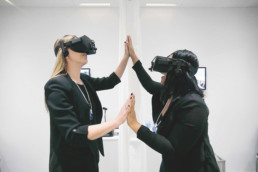
The Machine to be Another is an embodied virtual reality system that facilitates a compelling experience of body exchange. It is based on a phenomenon called "body transfer illusion" in the neuroscientific literature. Be Another Lab started prototyping in 2012 to make this experience accessible to the public. Using techniques from virtual reality, cognitive science, and performance. The Machine to be Another allows you to see the world through the eyes and body of another person while moving and interacting by touching objects and other people present in a duplicated space.
The Machine to be Another is a unique system and the main invention of the Be Another Lab collective. It results from long-term research into the possibility of enhancing active perspective-taking and empathic concern. Since 2014, the collective used the Machine to be Another to address the problems of bias towards certain groups. He is active in the world of art and film interested in new technologies, subjectivities, perception, and narrativity. He collaborates with scientists to better understand the phenomenon of embodiment. He works with civil rights activists in contexts where migration, mediation, conflict resolution, care, a therapeutic extension of the body, and intergenerational bonding are of primary concern.
BeAnotherLab is an interdisciplinary research lab dedicated to exploring the relationship between identity and empathy. They develop immersive technology systems to generate new narrative modalities and experiment with the perception of the other and the self. The lab works at the intersection between art, science, and technology, questioning the hierarchy between these different ways of generating knowledge and seeing them as complementary and intertwined.
BeAnotherLab consists of members based in São Paulo, Barcelona, Madrid, Berlin, Amsterdam, Zurich, and New York, with the birthplace of the project being Barcelona, the favourite place of many of its members and where it is registered as a non-profit association. The collective's work is licensed under a Creative Commons Share-Alike license. Specialties covered within the collective include cognitive science and psychology, interactive systems design, digital art, computer science, cultural management, philosophy, as well as conflict resolution.

Telenoika
Founded in 2000, Telenoika was created as a collective of people interested in audiovisual experimentation and with the aim of sharing knowledge and making the general public aware of the innovations that are taking place in artistic languages, thanks to the democratisation brought about by the new domestic audiovisual technologies. After more than 22 years of activity, Telenoika has managed to bring together a large community of artists interested in interrelating, developing and showing their concerns to society. At the same time, the community interacts with the outside world by maintaining relations with other associations, individuals, groups and companies linked to the field of new technologies. They have a collaborative networking platform, resources, a video library and a wide range of creation, dissemination and training activities.

Matias Verderau
Director Lichen Innovación Social, Degree in Business Management and Administration, Master of Science in Marketing and Master in Branding. Professor at the Autonomous University of Barcelona. His main fields of interest are Social Innovation, citizen empowerment through open technologies, participation dynamics and experimentation processes, through creativity, technology and education. He has experience in the Direction and Management of European Union Projects (Digital Social Innovation EU, Distributed Design Market Platform, Robotics for Microfarms (ROMI)), Community Management in relation to Citizen Science and open data (Making Sense EU, WeCount EU), and developing Social Innovation projects with public, private, academic and social organisations, such as the Living Lab for the process of democratic Digitalisation of Educational Centres of the Barcelona City Council (BIT-A-BIT Living Lab), the creation of a Social and Urban Innovation Laboratory in Santa Cruz, Bolivia (LAB11 +), the Applied Digital Rights Initiative (ADRI) of the Cities Coalition for Digital Rights promoted by cities in the United States, Canada and Europe, or developing community artistic interventions such as Ressons, Assemblea Sonora, among other Social Innovation projects in different areas such as Sustainability, Mobility, Education, Cultural Democracy, Urban Planning, Urban Health, Digital Inclusion, etc, mainly in Europe and Latin America.

Participation and Citizen Empowerment: Methodologies of experimentation and collective practice
The objectives of this workshop are 1) To promote public-private-community collaboration; 2) To favour Open Innovation and collective intelligence; 3) To promote participatory processes to favour spaces for meeting, dialogue, and learning; 4) To promote methods for collective diagnosis and ideation and encourage the co-creation of solutions on a local scale; 5) To encourage the implementation of participatory dynamics and interventions through analogue and digital tools (Collective mapping, participatory diagnostics, surveys.... ) and 6) Promote collective exploration and experimentation as learning processes with social impact.

Laia Estañol Salvador
Graduate in Art History from the University of Barcelona (2019) and Master's Degree in Cultural Heritage Management and Museology from the same university (2021). She specialises in the world of cultural management and heritage. She currently coordinates and leads strategic projects and their implementation in Adhoc Cultura, as well as the development of educational plans for various museum and heritage institutions. She is also an educational facilitator and is trained in methodologies such as Design Thinking.

José Ramón Ubieto
Clinical psychologist. Member of the World Association of Psychoanalysis and the Lacanian School of Psychoanalysis. Lecturer at the Universitat Oberta de Catalunya (Psychology and Educational Sciences Studies) and collaborating lecturer at the Universitat de Barcelona (Master's Degree in Psychopathology and Psychoanalysis). A regular contributor to the newspapers "La Vanguardia" and The Conversation, he has published in various national and international journals. Author of "El trabajo en red. Possible uses in Education, Mental Health and Social Services" (Gedisa, 2009), "La construcción del caso en el trabajo en red. Theory and practice" (EdiUOC, 2012), "ADHD. Talking to the body" (EdiUOC, 2014) and "The post-COVID world. Between presence and the virtual" (Ned, 2021). Co-author of "Niñ@s hiper. Infancias hiperactivas, hipersexualizadas, hiperconectadas" (Ned, 2018) and "¿Bienvenido Metaverso? Presencia, cuerpo y avatares en la era digital (Ned, 2022). She has coordinated: "Bullying. A false exit for adolescents" (Ned, 2016), and "From Father to iPad. Families and networks in the digital age" (2019, Ned).