
Freeport
A creative research program for a world of humans, non-humans, and machines. Freeport is an independent study and production program led by artists, combining art methodologies with a radical design, critical technologies, new visualities, and the cultural ferments and even fervour of Internet communities. Their goal is to test new ways of exploring the networked planet, developing creative strategies that can seize new aesthetic opportunities and expose the ambiguities and technopolitical blind spots.
Freeport is a spin-off of The Influencers, a festival about unconventional art, guerrilla communication, and radical entertainment, founded in Barcelona by Eva & Franco Mattes and Bani Brusadin in 2004 and whose 15th edition took place in October 2019 at the Center of Contemporary Culture of Barcelona. Freeport builds upon the path opened by The Influencers and aims at broadening its strategy.
As an independent program, FREEPORT is about unconventional learning, rather than traditional education. The current academic structures often fail to catch up with the challenges that a data-driven, politically confusing, but aesthetically lively society poses to education and creative production.
FREEPORT responds to such challenges by putting unconventional creative practices at the forefront of a new type of non-corporate innovation. Using art as a methodology, we encourage both recognized and young experts to share their skills and discover new paths in the entangled, ever-changing patchwork of forces that aesthetically, materially, and politically shape our networked planet.
FREEPORT has been initially developed as a series of short pilot programs (2018-2020), preparing the ground for a longer independent study program, open to collaborations with academic and non-academic organizations.

The Influencers
Every year since 2004 The Influencers festival has been inviting artists, hacktivists and researchers to share with the audience their experience with rebellious projects, inventions and adventures in the unstable realm where everyday technology and collective imagination collide, often times with unexpected results.
We've been talking about art and networks, new and old pranksterism, fakes and hoaxes, online user cultures, radical memetics, critical engineering, up to urban exploration and hacking, touching upon general topics as the materiality of the internet, mass surveillance, the symbolic efficacy of images, the power of fiction in the age of social media realism, collective intelligence and the role of the artist, innovation through remix and hacker culture, among many many others.
Also, at The Influencers there will be always room for fringe, visionary, crazy ideas. An example? Zero gravity theater, a tall bike gang, setting up a bot to buy stuff on the darknets, collecting patches of US army secret missions, or sculpting radioactive materials (among many many others). More than ten years since its first edition, the festival has grown to become a renown cultural event in Barcelona and Catalonia, with an increasing international repercussion.

Crowdcoop
Crowdcoop is the intersection between cooperativism, ethical finance and the innovation that comes from crowdfunding. Because the how counts as much as the what: Crowdcoop is a tool for financing a project and also an ally, because the circulation of money is not neutral.

Javier Carrillo Palacios
Coordinator of crowdfunding platform Goteo since 2018, he has previously worked as a web developer at Goteo and other entities related to the cultural and cooperative sector.

Víctor Jiménez Sánchez
Víctor Jiménez Sánchez is a cultural projects engineer, cooperativist, cultural manager, musician, producer, researcher in digital community culture, and social activist. In 2010 he graduated from the Master in Sound and Music Technologies at the Universitat Pompeu Fabra (Barcelona), after graduating in Telecommunications Engineering and Telematics Engineering. In 2008 he co-founded the sound studio "Wave Factory Studio" where he has been working since then as a sound engineer and music producer. From 2008 to 2019 he worked at the i2CAT Foundation coordinating research projects, cultural innovation, and digital society. Since 2012 he works for the Institute of Culture of the Barcelona City Council (ICUB). In 2017 he co-founded Bit Lab Cultural, a cooperative where he coordinates digital and community culture projects for social transformation. He is also a musician and producer of the experimental rock band Gambardella, co-founder of the label and independent music production company Pick Your Twelve and since 2011 he coordinates the pedagogical innovation project Escuela de Rock. As a cultural activist, he participates in different spaces and organised social movements such as the XES (Solidarity Economy Network) of San Andreu, the cultural activities commission of the FESC (Solidarity Economy Fair of Catalonia), the Caixa de Resonància - CDR of SMAC! (Union of Activist Musicians of Catalonia) and Cultura Coop.

Kaleido
Kaleido is an interactive and multimedia platform for the art world. Augmented reality (among other technologies), enriches the experience of engaging with art, both online and offline.
Its mission is to transform how art is shared, sold, and experienced today, taking into account the shortcomings of the visual arts sector, which is currently limited to a marketplace mode.
At Kaleido, the relationship with artwork is something that goes far beyond a simple image or object. Its history is something much deeper than a description of materials, measurements, and price. Thanks to technology we aim to deliver an enriched experience that does justice to true storytelling and opens up a range of new possibilities for creative expression.
Updating prices, generating catalogues, managing available work, generating certificates of authenticity, and updating and directing traffic to the portfolio, among others, are tedious actions that are part of every artist's day-to-day life. Actions that thanks to a technology specifically designed for the niche can be radically optimised, giving back time to creators for their creative process.
Kaleido is still in the beta phase of improving its product and actively listening to the needs of its community of 20,000+ artists in 168 countries. Both collectors and artists deserve a better platform to share their passion.
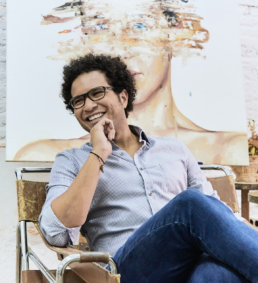
César Biojo
César Biojo (1981, Colombia) is an internationally recognised artist based in Barcelona since 2006. He holds a double degree in Fine Arts and Art History from Florida State University (2005, USA) and a Master's degree in artistic research and production from the University of Barcelona (2008). Motivated by technological frustrations in the sector and repetitive actions in his daily life as an artist, he founded Kaleido, an interactive platform for the art world that uses technologies such as augmented reality and virtual reality to enrich and transform the experience of how art is shared, sold, and lived.

Xènia Gaya
Graduate in design from the Elisava school, postgraduate in cultural management and policies from the UB, awarded the Irene Vázquez 2022 scholarship by the Eada Business School to study a general management programme, developing the Col-lectiu Cultura project. Digital transformation in non-metropolitan territories as a tool to cross borders and reach new audiences. Cultural projects that focus on the balance between offline and online. The implementation of digital resources in internal areas is a priority for the organisation.

José Valenzuela Ruiz
Born in Terrassa in 1982, José Valenzuela is an engineer and holds a PhD in humanities. He has worked in laboratories such as the Nanomaterials and Microsystems Group at the UAB and the Neuroscience and Virtual Reality Research Group (Eventlab) at the UB, in the innovation area of the Hospital Universitari Vall d'Hebron and at the digital agency VISYON. He currently divides his time between his work in neuroscience at the Brainlab at the University of Barcelona, teaching creativity at the UOC and writing for Jot Down Magazine and other media. She is also developing a second PhD in neuroscience and artificial intelligence in the search for neural biomarkers of neurodevelopment in newborns and infants.

Citizen innovation
In this round table, we want to meet creators, managers, and projects that are designing and developing technological initiatives to open up technoetic commons to citizens, to dynamise and democratise access to culture. We are interested in discussing the ethical use of digital platforms to create, share, connect and promote communities. On the other hand, we will also explore how to enable affective cartographies that promote networking and the strengthening of citizen and participatory ecosystems. We are interested in generating debate to bring together the relationship between the Sustainable Development Goals, the circular economy, the social and solidarity economy, the digital commons, and the construction of social, cultural, and economic alternatives that promote social transformation and guarantee decent, socially responsible, and techno-ethical work.