
Zero Grados
Zero Grados is an online magazine created within the University of Zaragoza, as part of the Journalism Degree, and it is committed to culture and narrative journalism as two of its main pillars. Each member of the team has different hobbies and interests and sees life from a unique perspective. We are a heterogeneous mix of multiple situations, and that is reflected in our writing. Literature, art, cinema, feminism, sport, theatre, philosophy, social issues, urban art... converted into narratives, chronicles, reports, profiles, or interviews. There is room for everything in this amalgam of letters that makes up our magazine. We like extraordinary lives, curious subjects, crazy projects, and different initiatives. We also experiment, we mix, we give our opinions and we discuss. And sometimes we are wrong.

Pueblos en arte
A cultural platform that connects the art of the cities with the rural environment and the people with the artist, generating new ideas from the countryside. It is committed to art and culture as tools to reactivate territories affected by depopulation. It develops projects in collaboration with institutions, entities, and cultural agents interested in this subject. It has inspiring spaces to work in, places to enjoy culture, and creates new models of local development based on socio-cultural exchange with neighbours.
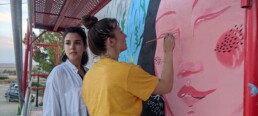
MAR Mujeres Artistas Rurales
It is a platform of rural artists and craftswomen that seeks to make visible, geographically locate, promote, and encourage the work developed by rural creators in Aragon through small format exhibitions, traveling festivals, and a website and a search engine for creators that facilitates the creation of networks and synergies and the development of cultural projects in rural areas. The only requirements to be part of MAR are: to be an artist or craftswoman, be over 18 years old and live in rural Aragon. To register you have to fill in the registration form that can be found in the "Join" section of the website, www.mujeresartistasrurales.es.

Pirineo Literario
Pirineo Literario was born out of the love of books and the mountains; reading and walking, walking and reading. To make known and care for the literary heritage of the Pyrenees and to offer the possibility of traveling through it with a different perspective: there is a great variety of cultural resources of great value linked to the literary heritage of this region. Through this project we aim to provide a solution to the need for a model of sustainable development in our valleys, which assumes new ways of recovering the literary heritage and cultural promotion; which meet the demands of both visitors and the current inhabitants of the Pyrenees, from a better coordination and communication of the existing actions and from the proposal of new ones. Pirineo Literario aims to make visible and interconnect all the cultural proposals linked to reading that are organized in this place. For the moment, the project covers routes, destinations, and literary landscapes in the counties of Sobrarbe and Ribagorza. On its website, there is reading cartography, where those interested can trace the authors according to the location of their works.

Espacio Infoculture
For 20 years, the website www.infoculture.info has been compiling information on scholarships and grants, and employment in the cultural sector. It has a digital bulletin and an on-demand alert service, through Selective Dissemination of Information (DSI). It currently provides a service for cultural agents in the city of Huesca.

Cartographies in the digital age: virtual travels, mapping and physical translation of data
In his virtual exploration Journey to the Center of Google Earth published in Altaïr Magazine, the chronicler Simon Sellars delights in the multiple digital textures in 360 degrees proposed by this new way of experiencing cartography and writes: "If the colonial point of view of Mercator's maps is an uncomfortable way of settling on the planet (hoping that the others, the un-civilized, stay in their place and do not shake the established order), then Google Earth, with its derivations - Google Maps and Google Street View - is a parallel world that infiltrates it".
In this "parallel infiltration" that digital cartography represents, the arbitrariness and vision of the dominant countries have not disappeared. But, by their very nature, the new digital maps allow us to navigate, read and inhabit them, making our own decisions, being more active, interacting, and producing as users new contributions to a type of cartography that is under permanent construction.
Virtual travel through Google Earth stimulates a series of new literary, visual, and interactive narratives. A good part of them is inspired by video games, a language that could be considered the pioneer in proposing narratives of the virtual movement. Many artists and creators think and execute their journeys in this way, without a concrete physical displacement, using digital cartography.
Madrid-based illustrator and graphic designer Miriam Persand takes virtual walks and turns them into drawings. Through virtual trips through Iceland, Ulan Bator, or the United States, she downloads photos uploaded with the hashtag #turismostreetview and transforms the people portrayed into crocodiles. He has even recreated the streets of the video game GTA San Andreas.
Canary visual artist Jonay PMatos went a little further with Google's StreetView and conducted an experiment that consisted of creating 360-degree images from photographs that he rotated on the same axis. And he uploaded them to Google Maps like any other user who made his cartographic contributions for certain locations, only in this case they were distorted, exaggerated and erroneous images, spaces as incoherent as they were disconcerting. Even so, the algorithm remained unnoticed for a long time and the artist kept receiving e-mails from Google encouraging him to continue collaborating and uploading photos after the more than 12 million visits to his images that directly perverted the space of Google's digital cartography.
Digital mapping against dispersion
 In addition to allowing us infinite virtual displacements and creative games with geography, digital cartography brings with it the concept of digital mapping, that is, the application of different digital tools designed to generate visualizations of data and information that would otherwise be scattered, disordered, and often inaccessible. From a given classification or a specific list idea, new maps can be created by grouping loose and dispersed elements. And within the Digital Ideas ecosystem, there are many such projects.
Migración y Cultura, for example, is one that has been initiated in Madrid but aims to expand to other parts of Spain. It consists of mapping artistic-cultural projects carried out by migrant people, collectives, and agents. Another case is Civics, an online platform that maps citizen initiatives of various kinds (urban gardens, bike routes, neighborhood solidarity projects), with the particularity of having its code open for the automation of projects, i.e., so that anyone can join and add their work directly, as long as it meets the thematic requirements.
During the COVID-19 pandemic, the online festival Frena la Curva emerged, designed to unify many citizen initiatives around the same digital space and with the idea of responding to a common challenge: to channel the social force and generate citizen support to different public and private organizations that were overwhelmed by the pandemic, promoting, for example, the creation of digital maps to facilitate the organization of solidarity networks with the most vulnerable people. This initiative, which emerged from Laboratorio Aragón Gobierno Abierto (LAAAB), was awarded the prize for the best project in the "Strategy against covid" category at the Innovation in Politics Awards.
The city of Barcelona is crisscrossed by an infinite number of maps and routes of all types and categories. One of them is the Xarxa de Radios Comunitarias de Barcelona, a digital map that brings together all the radios of the city that are located around a participatory, investigative, and community radio communication project.
Also from journalism but, in this case, around a specific topic, the digital mapping project on the Spanish urban landscape was created by a journalistic team from Eldiario.es. More than 12 million buildings constructed throughout the territory were mapped, in a study through which the evolution and vertical and horizontal development of all the cities of Spain can be explored in great detail. The data used were those published on the website of the General Directorate of Cadastre, through which they have automated the download of data on the heights of 7,610 municipalities, with the exception of Euskadi and Navarra, which have their own cadastral body.
The challenge of giving physical form to the pixel
 Many of the digital mapping initiatives have to do with a specific way of working with Big Data, that is, with the dynamics of analysis, interpretation, processing, and communication of large volumes of data. And with the possibility that these have a physical form, that they can be translated into a certain materiality so that they can reach and be understood by everyone.
The Domestic Streamers team works with data visualization from this perspective, generating different artistic projects to help organizations and diverse groups in this transition. The director of its creative department, Marta Handenawer, explained it during the round table Emotionalizing in the digital world: "We saw that people were generating data for free and data dominated the world. But, at the same time, people felt that the data didn't belong to them. So, in this tension between 'we generate a lot of data but it doesn't belong to us', we thought it was interesting to use design and art to explain that data is ours, that we generate it, and that without people data doesn't exist".
In this sense, what Domestic Streamers tries to do is to "put the digital close to the body", for example, visualizing the whole network of hate that exists on Twitter. For an exhibition, they studied a report of the most used words on the social network to inflict harm to other people and chose the first three: "nigger", "faggot" and "whore". Under each one, they placed a hammer connected to a motor and every time a hate tweet using that word was posted, the hammer was activated and broke the gallery wall. In this way, they managed to transfer the destructive digital action (also anonymous and invisible) of a hate network to the physical visibility of a museum.
Sergio Rodriguez was another participant at that table, as the founder of Nomad Garden, an urban digital mapping project linked to gardens. "We work with the urban environment, with vegetation. And, therefore, our desire has always been to approach the whole reality of urban vegetation, of the plants that are around us, to awaken a little of the memory they have, to problematize the gardens, the streets, and the orchards that people make in a popular way", commented this architect specialized in urbanism and landscape. And he wondered: "Where does the information operate and where does it open up? Where does the interaction take place? Normally it seems that this interaction is always at home, with the cell phone. But how can you establish another kind of dialogue where information doesn't just happen on the other side of the terminal in a dark room? Where information really opens up and unfolds in a synaesthetic way. For example, we are very interested in all that information that opens up, for example, under a jacaranda tree. And, in addition, at a given time, when it is in bloom. And that information is related to a specific color and smell. And maybe it's occurring only in a place where you have to go. And the information is located again.
Nomad Garden's projects are not limited to a single format but try to capture the particularity of the gardens they map and their respective plants. In Las Palmas de Gran Canaria, for example, they generated a series of sounds and songs related to many stories linked to that vegetation. And in Seville, after the mapping work in a garden, they contacted a French perfumer for the creation of a perfume that gathers the essences of some of these plants and reflects all the power of their characteristic aromas.
There is something of this in the obsession of Pedro Montesinos and his soundscapes. This Canarian traveler travels through different geographical environments of the Canary Islands and carefully records the characteristic sounds of the stones, the wind, or the waves, generating a very personal geographical sound log and, simultaneously, cartography of sounds of very specific places.
The digital has reached the cartographic science to expand the idea of map, to promote virtual trips that question the classic notion of displacement and to generate associationism through mapping technology. And, on the other hand, it has brought with it a challenge that many continue to take up and navigate: how to translate the large volume of digital data into physical and, therefore, more palpable realities.
By: Laureano Debat

Technofeminism: Technology from a Gender Perspective
Technofeminism is a term created by Australian sociologist Judy Wajcman and defines the link between feminism and social studies on technology. Being a technofeminist or working around technofeminism implies thinking and developing technological initiatives and products in two ways. On the one hand, aimed at vindicating the role of women in the production and use of technology and, on the other, at thinking about the history and present of women's relationship with technology from multiple angles: patriarchy, mutual care, art or communication. What Wajcman states in the book where the term appears for the first time, entitled "Technofeminism" and published in 2004, is that techno-scientific advances are radically transforming the woman-machine relationship and that new technologies are also gendered, both in their design and in their use, so that occupying spaces in ICTs for women implies linking up with spaces of power that were historically denied to them.
In an article published in the September 2021 paper edition of Pikara Magazine entitled "Technofeminism. Beyond the hacker myth", journalist and philosophy graduate Teresa Villaverde emphasizes the importance of analyzing the concept, leaving behind the commonplace of sabotaging institutions, the conventional idea of hacking from self-conscious and antisocial eggheads who, just for fun, seek to fuck the system. What the author says is that, if hacking exists in the female sphere, in most cases it has emerged as a response to harassment, violence, and male chauvinist injustices of various kinds. So when we talk about techno feminism, the idea of hacker acquires another nuance that is rarely taken into consideration and expands to "groups of programmers, consultants and technologists who work with a feminist perspective, from the collective and outside the paradigm of the genius programmer, to configure more inclusive technologies," as Villaverde writes in her article.
Ideas Digitales is a platform that serves as a repository, map, training, and inspiration channel for a growing community of agents who apply their creativity to adapt to the new digital times. And from here the concept of cultural hackers is coined, as a network of digital creators in different fields that make up an ecosystem of cultural innovation and that, in the context of technofeminism, have much to say and contribute.
At the roundtable "The digital revolution: this world is already another", an initiative within the "Learn from the best" section of Ideas Digitales, the guests discussed whether our bodies and minds have already adapted to this new technological metabolism and whether or not technology drives progress in the world. Participants included the director of the Peccata Minuta project, Cristina Abelló, art curator Semíramis González, and writer and journalist Cristina Fallarás, who commented: "For the first time in the history of humanity we can communicate globally using social networks without capital investment. This is a radical revolution because it generates universal solidarity, so that if I say something here it connects with what a woman in Japan says and what a woman in Canada says. And that has never happened before in the history of mankind. And that generates the possibility for those who are against the established power to communicate".
Cristina Fallarás was part of the #Cuéntalo project, a hashtag that was launched in 2018 on Twitter and through which, from the Barcelona Supercomputing Center with the specialist in scientific data visualization Fernando Cucchietti at the head, nearly 3 million tweets were analyzed that resulted in more than 160 thousand stories of sexual aggression. The result is a historical document that adds to the collective memory of male violence narrated by the women victims themselves and is key to understanding the enormous dimension of the conflict.
In this way, technofeminism constitutes a network of complicities that seeks to transform the world through a radical change in patriarchal culture. And a good start is always education, as in the case of the All women tech project, the first academy of the technological profile created by women and for women aimed at online training in different digital fields: data science, data analytics, and content design. Through its Crowdcast channel, you can access lectures, classes, and debates on technology and the gender gap.
 It is not a minor fact, nor does it mean an exclusive position that All women tech is an academy only for women and that it is within the ecosystem of Ideas Digitales. The fact is that the technological and digital field has always been dominated by men and it is time to do justice, equalizing quotas and offering equal opportunities. From this logic Digital fems is also born, an instance created for the design of digital projects that promote and increase female participation in technological environments. And always under the concept of creating diverse and plural teams within companies, public institutions and all types of organizations from the creation of innovation plans in diversity and hackathons.
And while technology advances rapidly, the different forms of gender violence remain intact and are expressed in multiple aspects. That is why a platform such as Data against noise, included in the "Strategies" section of Ideas Digitales, becomes essential within technofeminism. Through tools and techniques of Big Data, mapping and other methods for the management of large volumes of data, this website publishes and makes visible all the information available from the judicial system and the police on male violence in Spain: gender violence (that which is exercised within a couple or ex-partner relationship), domestic violence (that which is exercised in the family environment) and violence against sexual freedom. In addition, they promote collaboration not only by offering the download of all the contents, but also by giving the opportunity to feed the database through different mechanisms and to disseminate the data in different social networks.
And, of course, the field of culture continues to resort to necessary rescues, to outstanding debts that history has with respect to the role of women. Very recently, the auditorium of the art and technology center Etopia in Zaragoza screened "Sisters with transistors", a documentary dedicated to the pioneering women of electronic music and which tells their untold story, their role as innovators through machines and their liberating technologies to completely transform the way music is produced and listened to today (the film can also be seen on the Filmin platform). The screening was part of the Efluxión project, a podcast by art historian María del Castillo on contemporary culture and where topics related to fashion in the future, digital landscapes, and work on the internet are addressed.
Etopia also has a project entitled Academia Fachada Media, through which artists from all over the world are invited to intervene in the facade of the building. One of the latest interventions was in charge of Slovak visual artist Silvia Binda Heiserova, who used photos uploaded to Instagram under the hashtag #woman to elaborate a critique of the visual representation of women, manipulating those images until achieving an abstract landscape, proposing a three-dimensional geographic and geometric exploration through the digital image projected on the facade of a building.
Another key name in Spain when talking about technofeminism is Mariona A. Cíller. Cíller, president of Habilis per Abacus Cooperativa and co-founder and creative director of SokoTech, a specialist in technology and education. With SokoTech she struggles since 2015 to develop a digital social innovation laboratory where projects linking arts, science and technology are produced. A work that they themselves link within a "cross-pollinated nature", a sort of synthesis of knowledge in various fields, academic and non-academic. A team in which the majority of its members are women.
The Bekka is a common space for learning about free culture, technology, and feminisms. A collaborative environment especially composed of heterosexual women, lesbians, and trans people, against the traditional conception of most of this type of technology labs in which cis men predominate. This is how they state their objectives: "To empower ourselves and take over the machines, and also in a theoretical/reflective way, generating a critical and feminist discourse on technologies". They work on issues related to free software, social networks, privacy and global surveillance, techno-politics and cyberfeminism, recycling, and programmed obsolescence, the gender gap in technologies, critical and feminist digital literacy, digital protection, and feminist digital self-defense.
In several of these areas, especially in terms of security and technological surveillance, Gemma Galdon is one of the great specialists in Spain. She has developed her work as an analyst of the social, legal and ethical impact of technology, smart cities, privacy, security policies, resilience and policing. She is a founding partner of Eticas Research & Consulting and a researcher in the Department of Sociology at the University of Barcelona. In her latest academic publications, she addresses the proliferation of surveillance in urban environments, local security policies, community policing, security in large events, the relationship between privacy and technology, and smart cities. All this, from a strong gender perspective that she shares with Susana Sanz, information security advisor, hacktivist, and Spanish consultant living in Amsterdam, a teacher in digital self-defense within the Balkontactics platform, where she teaches everything necessary to protect the security of digital devices and connections, keep abreast of the latest threats in the field of digital security and to understand how the Internet works, to prevent risks and take the necessary measures.
The technology and digital culture festival Sonar+D, parallel to the electronic music festival Sónar in Barcelona, also take care to have among its guests each year activists, artists, and references of technofeminism. This 2022 was the turn of Constanza Piña, a visual artist, dancer, researcher, and educator born in Chile and focused on experimentation with electronic media, free technologies, and DIWO ("do-it-with-others") methodologies. Piña performs a scenic work that unifies sound performance with dance, proposes works that break the fourth wall, incite audience participation and promote exploration of noise in its cultural, political, and sonorous functions, questioning the role of techno-hetero-patriarchy, anthropocentrism, and machines in capitalism.
It has been almost twenty years since Judy Wajcman invented the concept of technofeminism. Today we are living an unprecedented moment of multiple experiences and initiatives related to this essential field in all areas of thought and action crossed by new technologies. We invite you to continue deepening and knowing some of them in Ideas Digitales.

Digital art and science: the ultimate alliance
For a long time and in the vast majority of educational institutions around the world, special attention was paid to the pedagogical approach called STEM (Science, Technology, Engineering, and Mathematics), which encompassed science, technology, engineering, and mathematics. The idea was to awaken these vocations in young people at school and to have well-trained professionals to face the new challenges of a global society.
But the general loss of interest in science subjects among many students in the United States became inevitable. So the Massachusetts Institute of Technology (MIT) came up with the idea of incorporating art and design into the acronym, both disciplines designed to collaborate with the sciences in order to rekindle interest in them. This is how the concept of STEAM arises, through which artists and scientists not only share the same status but work in direct alliance in an increasingly technological and digital world, in which mathematics, plastic art, engineering, and literature are no longer conceived from watertight compartments but put in common and as allied concepts, building synergies to help both in learning processes and in other aspects of creation and life in general.
Within the Digital Ideas project, which seeks to analyze how the most independent cultural sector is being digitized, this meeting between art and science is essential. Among the proposals identified is Hyper Studio, a group made up of young people from different disciplines and whose location is purely digital. Their work focuses mainly on linking architecture with digital media in interdisciplinary interactive design projects. Their initiatives range from the urban everyday life of the city of Tokyo to the installation of interactive virtual reality devices at festivals, as well as the development of virtual platforms for different clients. And although their projects have a very diverse character, all of them are marked by this alliance between science and digital art.
Pablo Barquín and Anna Díaz Ortuño from Hamill Industries work in a similar way, although in their case they converge diverse technologies with visual arts and explorations around light and sound. In this way, they manage to create their own tools and invent digital and analog artifacts for various projects, always under the obsession of achieving unique designs, universes, and audiovisual experiences for video clips, commercials, art installations, and performances.
In an interview for Efeminista, the computer engineer and director of digital communication at the University of Deusto, Lorena Fernandez, says that "digital art is a beautiful window to bring STEAM to young women" and claims the role of women, never sufficiently recognized, in the beginnings of the creation of different programming languages. Together with Pablo Garaizar and Iñigo Maestro, Fernández has created the board game Nobel Run, which aims to bring women closer to scientific careers and through which they can manage research teams to win the Nobel Prize, with the challenge of obtaining funding, hiring staff and publishing articles in scientific journals. All this is under a playful experience that is located in the same line as Cienciaterapia, a project carried out by different scientific teams within hospitals where children with cancer are treated and through which interactive experiments are offered to do with the family. In this way, the necessary funding is obtained so that children undergoing treatment receive scientific workshops and can cope in the best possible way with the difficult situation in which they are immersed.
Science linked to culture can be very useful to bring us closer to the maximum possible empathy in the face of realities that are often difficult to feel if they are not experienced firsthand. To bridge this gap, the Be Another Lab project proposes a much more empathetic dimension of otherness, in relation to what the migrant and refugee population suffers on a daily basis. Through the recording of first-person stories in virtual reality, anyone who puts on the glasses will not only be able to see but also experience what the most vulnerable groups suffer on a daily basis. In a similar vein, but in this case linked to trauma and mental health, is Locus, an initiative that arose in the district of Vallecas and seeks to subvert the concept of a "place of safety" (always associated with police environments and health centers, according to the logic of psychiatry) and proposes other contemporary creative languages to vindicate coexistence with madness through the use of virtual reality.
Festivals and laboratories
 The preeminence of more and more festivals and permanent labs linking digital art and science is very helpful to strengthen STEAM pedagogy strategies in their drive to generate interest in technology and science careers. And, at the same time, they are fundamental instances to help the general population to reflect on the fundamental role that science plays in the one-way path that culture is taking toward digitization.
Digital art projects made in collaboration with artificial intelligence and crypto-art with works born from NFTs were the predominant lines in the last edition of Sónar+D in Barcelona, the parallel meeting organized by the electronic music festival Sónar, which was born with the idea of generating a space for interaction and exchange between scientific and technological disciplines, art and digital culture.
The digital and audiovisual art exhibition Madatac has ten editions under its belt, always under the logic of unifying the most avant-garde manifestations in online and face-to-face formats. Each new edition of this festival brings together more than a hundred artists from around the world to exhibit their projects related to immersive experiences, virtual reality projections, or 360º equirectangular videos. The common denominator is the scientific and technological experimentation that is at the base of each of the works.
In its fourth edition, Me gustas pixelad_ was concerned with the investigation of the different edges that make up trauma and how digital art can respond to it. Through a hybrid format, face-to-face and online, this festival promoted by Casa Encendida presented ten pieces by 13 artists who proposed different ways of approaching, seeing, experimenting, and expanding the meanings of care, healing, and management of a traumatic event.
Also from Madrid, the Medialab laboratory at El Matadero offers a fruitful space for the confluence of artists, designers, and scientists, incubating multidisciplinary projects in which different branches of science, digital art, and what is known as new media converge, that is, the media and entertainment born from the digitalization of their contents.
With the idea of promoting the creation and pedagogy around sound art, both from research and from the link with other artistic and scientific disciplines, the Festival de Nova Creació Sonora de Barcelona Mixtur proposes each year a series of concerts, conferences, educational activities, round tables, and installations to be a decisive bridge between the new experimental music and the general public, besides being a focus of discovery of new trends in sound art and a pedagogical instance that stimulates the formation of new artists and researchers in the area.
The stimulation of creativity and playful experiences that encourage interaction are at the base of everything. And that is something that can only be offered by digital art and its different branches and specialties that, in this case, join scientific disciplines to expand creation to levels unsuspected until a few years ago and that contribute to awakening interest in young people for careers and vocations that historically were seen as unattainable, difficult and distant. But the mediation of art has made them closer and possible.
By: Laureano Debat

DiOtherCity: Creating alternative tourist routes with digital tools
This training capsule offers a new way of conceiving cultural and tourist routes in today's cities, favoring the decentralization of activities to the urban peripheries and the incorporation of digital elements to attract and surprise visitors. incorporation of digital elements to attract and surprise visitors. We will explore different ways to devise an alternative urban route and the steps and resources necessary for its realization. We will also create a live alternative route, collectively and collaboratively, to illustrate some of the digital tools in more detail, explore their entrepreneurial possibilities and inspire the creation of new individual alternative routes in the creation of new individual alternative routes in the future.
Objectives:
- Encourage decentralized cultural tourism and the acquisition of digital tools.
- Promote collective exploration and experimentation as learning processes with social impact.
- Encourage the implementation of participatory dynamics and interventions through analog and digital tools (collective mapping, participatory diagnostics, surveys...).
- Promote methods for diagnosis and collective ideation and encourage the co-creation of solutions on a local scale.
- Encourage open innovation and collective intelligence.
- Promote participatory processes to favor spaces for meeting, dialogue and learning.
- Promote public-private-community collaboration.
Contents:
- Introduction to the DiOtherCity project and the alternative urban routes that have already been made.
- Creating an urban route collectively.
- We will see how to use Google Maps to make a customized map/route, and other digital and analytical tools that can strengthen the success of the route.
-Brainstorming on what digital elements we can include to make the route even more attractive.
- Why an alternative route can generate revenue and jobs for professionals in the tourism sector or creative and cultural industries -How can an alternative route be monetized?
-Reflections and conclusions of the session.
Contributors:
CEPS Projectes Socials
Trànsit Projects
EU/ Erasmus+ Programme
Danielle Bishop
Master in Modern Languages (Oxford University) and Master in Cultural Management (Universitat de Barcelona). She is a cultural manager dedicated to research, coordination, and management of cultural and educational projects. She seeks to apply her research and practical work on gender, community, housing, creative cities, and cultural tourism to the empowerment of multicultural and disadvantaged communities, as well as the disruption of gentrification and touristification processes. She is currently the coordinator of the European project (Erasmus+) #DiOtherCity, which has created an open course for professionals in the cultural and creative industries to rethink the current dynamics of tourism and create alternative routes to peripheral areas of cities, using digital tools.