
Esto no es un museo
Together with Ana Gracia, she runs the cultural management company Esto no es un museo, which connects museums and cultural institutions with audiences through the production of sound resources and cultural mediation experiences. From a multidisciplinary perspective, they combine the history of art and education and tackle the creation of new resources and tools to bring art and culture closer to all audiences. Their projects encompass analog and digital perspectives, highlighting their specialization in the production of podcasts about museums and exhibitions, as well as their pioneering cultural mediation strategies.
Pablo Lafarga
Together with Ana Gracia, she runs the cultural management company Esto no es un museo, which connects museums and cultural institutions with audiences through the production of sound resources and cultural mediation experiences. From a multidisciplinary perspective, they combine the history of art and education and tackle the creation of new resources and tools to bring art and culture closer to all audiences. Their projects encompass analog and digital perspectives, highlighting their specialization in the production of podcasts about museums and exhibitions, as well as their pioneering cultural mediation strategies.

Mural Hunter (Fundación Ibercivis)
Mural Hunter is a project that aims to preserve and catalog the urban art heritage of cities; an ephemeral and changing heritage made up of performances and graffiti that appear, mutate, and disappear. Through an app, which can be installed on a mobile phone, Mural Hunter allows you to photograph and geo-locate the works of urban art present in the environment that the interested party wishes to preserve. The result is an online catalog of urban art worldwide in which the works of this artistic manifestation are preserved indefinitely, even when the work has physically disappeared. Mural Hunter has been created by the University of Zaragoza. It is a project by Pilar Rivero at CIVITAS 2.0, a platform for citizen science and heritage dissemination that seeks to create materials and spaces for heritage education. So far, thanks to the collaboration of citizens with different profiles, 931 works have been cataloged, of which 817 are located in Spain and 250 in Aragon. The application has been designed within the framework of the Web 2.0 Heritage Education project, funded by Mineco/AEI and Feder (EU).
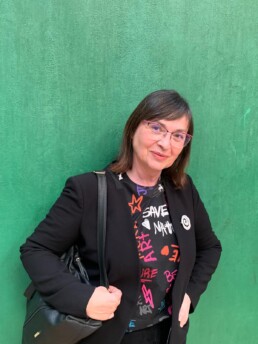
Pilar Rivero
She is a teacher and researcher. Professor at the University of Zaragoza in Didactics of Social Sciences, Principal Researcher of the ARGOS group. Her lines of research are the teaching of history and heritage and especially with the application of technological tools. She works on the application of citizen science and social networks to heritage education, in which context she has promoted the concepts of co-creative paradigm and heritage cybercommunity. Co-directs with C. Marta the project TED2021-131174B-I00 "Participatory digital tools to support cyber heritage communities".

Javier Roche
In his work as a photographer, he reflects on the landscape, how it is positioned, and how society inhabits and modifies it. After receiving a Cesar - Etopia Labs grant, he began to hybridize his knowledge of electronics and programming with photography. Since 2015 he has been a member of the Llámalo H Collective, which together with the Zaragoza City Council and the neighborhood of San José is responsible for managing the creative space Harinera ZGZ. Since 2021 he has been closely involved in REACC - Red de Espacios y Agentes de Cultura Comunitaria, an open assembly for dialogue and support among community culture professionals. He is also in charge of the promotion of free digital tools and digital sovereignty in the world of culture.
Citizen Participation in Digital Environments
This forum will focus on discovering the keys to techno-ethical digital participation that is respectful, sustainable, and has a positive impact on the community. A dialogue around the concept of community culture, starting from the democratization of access to digital culture and why it is important that everyone can produce and share their own culture in a techno-ethical way.
In addition, participants will reflect on what social and solidarity culture means when it comes to promoting, facilitating, and guaranteeing responsible consumption and sustainable production in the digital environment. They will also discuss the internet as a public and shared space, and the relationship between the digital sphere and the physical territorial environment of proximity.

Social economy and the cooperative model for digital projects
Fernando Giménez Pérez is Area Manager for Aragon and Catalonia at Laboral Kutxa. He has 30 years of professional experience in banking and training at the University of Zaragoza and the University of Mondragón. He is an active agent of the social economy with 23 years of experience in cooperativism within Mondragón Corporación Cooperativa (MCC).

Fernando Giménez
Fernando Giménez is a lecturer in the postgraduate course in Social Economy at UNIZAR and Director of Aragon and Catalonia at Laboral Kutxa. He has 30 years of professional experience in banking and training at the University of Zaragoza and the University of Mondragón. Active agent of the social economy with 23 years of experience in cooperativism within Mondragón Corporación Cooperativa (MCC).

Estampa
Taller Estampa is a collective of programmers, filmmakers, and researchers based in Barcelona. Their practice is based on a critical and archaeological approach to audiovisual and digital technologies. Over the last few years, they have carried out artistic research projects using artificial intelligence (AI) tools. In this session, they will address their particular appropriation of AI and its tools for the transformation of the meaning of images and writing. At a time when different technologies that mimic human capabilities are spreading, they will reflect on how they work, their potentials and limitations, and the myths and utopias that surround them. Starting from these premises, we will analyze our own creative expressions and those of others, trying to follow the trail of those experiments that, outside the big technological platforms, have tried to explore the non-normative uses of AI.

Héctor de la Puente
Visuals (VJing) improvised in real time, emphasising the visual cultures of each musical style.